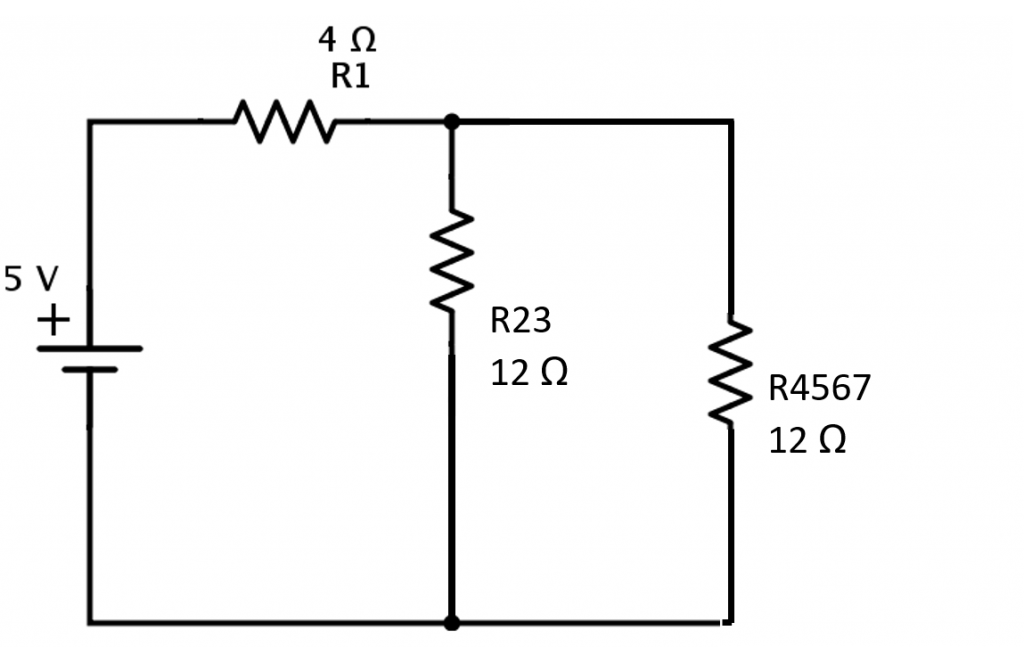
Now, we’ll “unpack” the circuit, working backwards to find the current through and voltage across each resistor. There are almost always multiple ways to do this. Below, there are two possible procedures for figuring out the current through and voltage across R1, R23, and R4567. Put each procedure in order, then use one of them to calculate the values.
Ohm’s Law (ΔV=IR) says that the voltage across a circuit element equals the current through the element multiplied by the resistance of the element. If you know two of the three terms for a particular circuit element, you can use Ohm’s Law to find the third.
Kirchhoff’s Voltage (or Loop) Law says that if you travel around a single loop in a circuit, keeping track of the increases and decreases in potential (voltage), when you get back to where you started, the total change in potential will be zero.
Kirchhoff’s Current (or Junction) Law says that the current that flows into a junction must equal the current that flows out of a junction.
In some cases, you can use proportional reasoning to simplify your calculations. If you know the total current that will flow into two parallel branches of a circuit, the current will split proportionally between the two branches, with the lower resistance branch receiving a higher proportion of the current.
Similarly, if you know the total voltage across multiple resistors in series, the voltage will be divided proportionally among the resistors, with the higher resistance resistors receiving a larger proportion of the total voltage.